
Is AI Safe for Healthcare Billing? What Practices Need to Know
Artificial intelligence is no longer a future concept in healthcare. It is already embedded in how many healthcare systems operate today. Across hospitals, clinics, and billing organizations, AI is being used to manage large volumes of data, reduce errors, and support teams that are under increasing pressure. As adoption grows, the conversation is shifting from whether AI should be used to how it should be used safely, ethically, and responsibly.
Billing workflows are complex, rule-driven, and time-sensitive, making them a natural fit for intelligent automation. Many automated medical billing companies now use AI to improve revenue cycle management, and insurance companies have piloted AI tools to streamline prior authorization processes. When implemented correctly, AI has the potential to improve billing accuracy and help maximize healthcare revenue for practicing physicians. However, alongside these benefits come real limitations and risks that must be carefully managed. Let´s explore it further:
How Common Is AI in Healthcare Today?
AI is already widely used across healthcare systems, even when it is not always visible to patients or providers. And recent data highlights just how widespread AI adoption has become. According to the American Medical Association, nearly two-thirds of physicians or otherwise, 66% reported using healthcare AI in 2024. This clearly shows that AI is no longer experimental, but increasingly part of day-to-day healthcare operations.
At the same time, the National Institutes of Health notes that healthcare is currently in an “AI as a partner” phase. Over the next five to ten years, AI is expected to become more autonomous and deeply integrated into routine workflows, moving beyond pilot programs into standard practice. Investment data also reflects this shift. Research from Menlo Ventures shows that 22% of healthcare organizations have already implemented domain-specific AI tools. Health systems lead adoption, followed by outpatient providers and payers.
So, many organizations are relying on AI-powered tools for billing checks, claims analysis, scheduling, reporting, and financial forecasting. And practices are not adopting AI because it is a trend, but because billing data volumes continue to grow while payer rules become more complex and staffing resources remain limited.
What do patients think of AI in healthcare?
Public opinion reflects both optimism and caution around AI in healthcare. Many Americans believe AI could reduce medical errors, with more people expecting mistakes to decrease rather than increase when AI is used. Among those who see racial and ethnic bias as a serious problem in healthcare, a majority believe AI could help improve fairness rather than make it worse.
A survey by Deloitte found that 53% of consumers believe generative AI will improve access to healthcare, while 46% think it will make healthcare more affordable. In billing, this can translate into clearer statements, faster issue resolution, and fewer billing-related frustrations.
At the same time, concerns remain strong. More than half of Americans worry that increased use of AI could harm the personal relationship between patients and providers. This concern reinforces the need for AI systems that support human decision-making rather than replace it.
To put this into perspective, it helps to first examine the benefits of AI in healthcare billing, before turning to its limitations and risks.
The Benefits of AI in Healthcare Billing
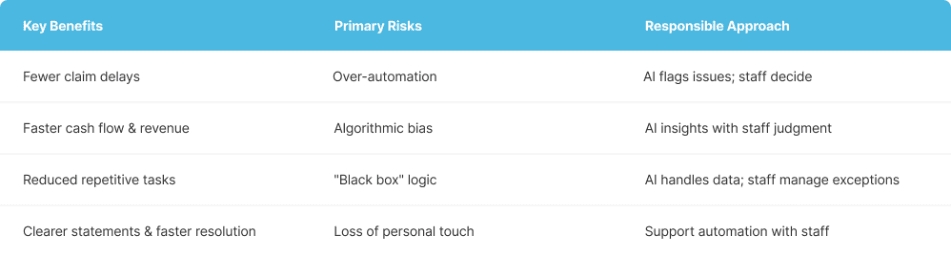
When used responsibly, AI offers meaningful benefits in healthcare billing. AI can analyze large sets of billing data quickly, helping identify errors, missing information, and denial patterns before claims are submitted. This preventive approach reduces rework and improves first-pass claim acceptance.
In general, key benefits include:
Fewer Claim Errors and Denials: AI can identify missing or incorrect data before claims are submitted, flagging potential issues automatically. Industry analyses and case studies show that AI-assisted billing can significantly reduce claim denials by identifying errors earlier in the process, with some organizations reporting measurable improvements after implementation.
Improved Cash Flow and Financial Predictability: Predictive analytics allow billing teams to anticipate delayed payments and adjust workflows proactively. In practice, clinics using AI forecasting tools report an 15–20% improvement in accounts receivable days.
Reduced Manual Workload for Staff: Repetitive tasks such as checking codes, validating insurance eligibility, and reviewing high-volume claims can consume hours each week. AI handles the bulk of these tasks, freeing staff to focus on strategic work such as payer negotiation, auditing, and patient support.
Enhanced Patient Experience: Faster claim resolution and clearer statements improve patient trust and satisfaction.
Insights and Revenue Opportunities: Industry research from, HFMA shows that AI‑assisted billing and automation tools can improve denial management and revenue cycle outcomes by helping teams identify errors earlier and manage exceptions more efficiently.
While the benefits are substantial, they are maximized only when AI is applied responsibly, combined with human oversight, and integrated into secure, compliant workflows. This is the approach Myriad Systems follows. It ensures that AI improves operational efficiency, financial outcomes, and patient trust without any risk. Tools like MyScribe AI help improve documentation accuracy at the point of care, ensuring clinical notes are complete, clear, and structured before they ever reach the billing process.
The Top Benefits of MyScribe AI for Modern Practices:
Save Time on Documentation: Case studies from Myriad Systems suggest that providers can save up to 1–2 hours per day on documentation by using MyScribe AI. By capturing notes in real-time, you can finish your charts before the last patient leaves the office.
Accurate E/M Coding: MyScribe AI analyzes your clinical notes to ensure your Evaluation and Management (E/M) codes accurately reflect the complexity of the visit. This eliminates "under-coding" (lost revenue) and "over-coding" (audit risk).
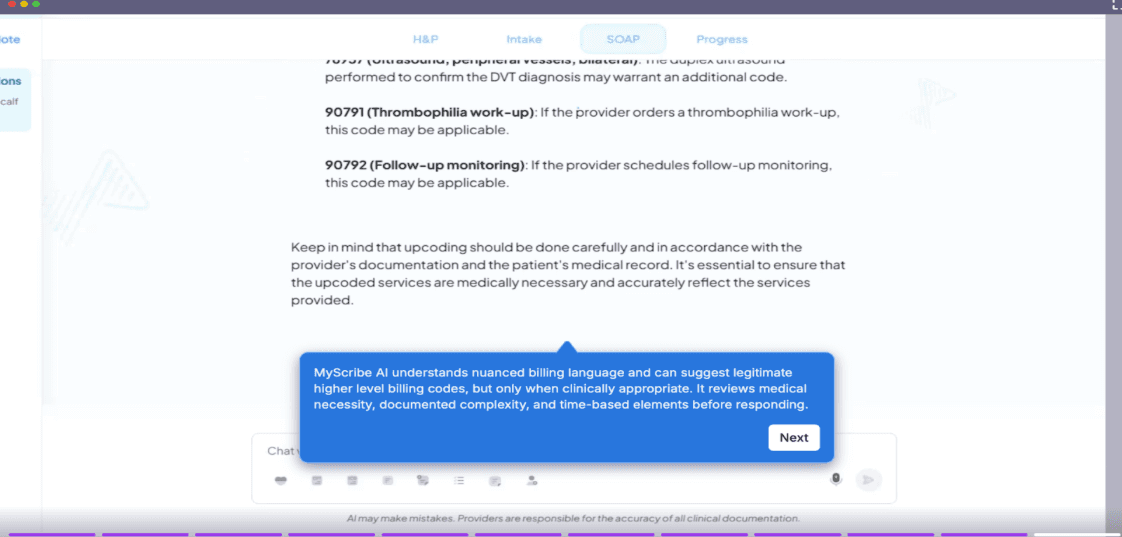
Clear and Concise Notes: Generate SOAP notes that focus on the actual clinical details without unnecessary repetition.
Seamless Integration: MyScribe AI lives within the Myriad Systems ecosystem, meaning your notes flow directly into your billing workflow without manual copy-pasting.
The Limitations of AI in Healthcare Billing
AI is indeed a powerful tool, but in healthcare billing, how it is used matters just as much as what it can do. Billing data contains sensitive patient and financial information, and any system that processes this data must be designed with ethics, privacy, and accountability at the center.
One of the biggest ethical risks of AI is over-automation. When systems are allowed to make decisions without human review, errors can go unnoticed and accountability becomes unclear. AI does not understand intent, fairness, or real-world consequences. It only recognizes patterns in data. This means it cannot fully interpret complex payer rules, unique patient situations, or ethical considerations on its own.
Another major concern is bias. AI systems learn from historical data. If that data contains errors, gaps, or biased patterns, AI can repeat or even amplify those issues. In billing, this can mean incorrectly flagging claims, misclassifying accounts, or unfairly prioritizing certain cases. Without regular review and human oversight, these inaccuracies can quietly impact revenue and compliance.
Transparency is another concern that we need to keep in mind. Some AI systems act like “black boxes,” providing outputs without clear explanations. Billing teams must be able to explain why a claim was flagged, delayed, or corrected, especially when dealing with audits, payers, or patients. AI that cannot be explained creates risk, not efficiency.
To addresses these concerns, it is important to use AI as a support tool rather than an autonomous decision-maker. Human oversight should be built into every workflow, ensuring that billing professionals remain responsible for final decisions. AI can be used to flag risks, detect patterns, and provide insights, while experienced teams stay present to apply judgment, manage exceptions, and maintain compliance.
The Risks of AI in Healthcare Billing
While limitations highlight where AI needs support, risks show what happens when AI is implemented without proper safeguards.
One of the most serious risks of using AI in healthcare billing is the potential for HIPAA violations. AI billing platforms process massive amounts of Protected Health Information (PHI), including patient identifiers, insurance details, and financial data. If this information is not properly encrypted, securely stored, or tightly controlled, it can be exposed to unauthorized users or third parties. Even a single data breach can result in major HIPAA penalties, legal consequences, and long-term damage to patient trust.
This risk increases when AI systems are rushed into use or connected to third-party tools without strict safeguards. Poor access controls, unclear data ownership, or lack of monitoring can allow sensitive data to be used in ways that were never intended. Compliance is non-negotiable. This is why ethical AI must include strong data protection, limited access, continuous monitoring, and clear accountability.
How to Use AI Safely in Healthcare Billing
In conclusion, AI is already shaping how healthcare billing operates, and its role will only continue to grow. It can reduce errors, improve cash flow visibility, and support overworked billing teams, when it´s used responsibly. But without ethical design, strong data protection, and human oversight, AI can also introduce serious risk.
Myriad Systems believes in using AI to support, not replace, experienced professionals. It should combine intelligent automation with human judgment, so practices can strengthen performance while maintaining compliance, accuracy, and patient trust.
This approach is most effective when it is grounded in a clear understanding of where breakdowns happen in the billing process, such as missed errors before submission, repeated claim denials, or limited visibility into revenue delays.
Understanding where gaps exist in your current billing workflow is often the first step toward improvement. From there, the right combination of tools and oversight can help create a more efficient and reliable process.
A practical way to identify those gaps is to ask yourself:
1. Are claim denials happening because issues are being caught too late?
2. Are staff spending too much time on repetitive checks?
3. Is there limited visibility into why revenue is being delayed?
If any of these gaps sound familiar, then it is a strong signal that your billing process could benefit from more proactive, insight-driven support.
You can explore exactly how Myriad Systems approaches this by seeing how tools like MyScribe AI fit into your workflow, or request a walkthrough tailored to your practice by visiting the Myriad Systems platform and booking a demo with the team.