HIPAA compliance is a set of standards that decide how your practice can collect, use, share, and protect patient health information. Most practices assume they're covered simply because they use a "HIPAA-compliant" system, but that label doesn't always mean what people think it means. The gap between assuming and being compliant is where small practices run into trouble.
For a small practice, HIPAA compliance requirements can feel like they were written for hospital systems with a full compliance department. They weren't.
This guide breaks down what HIPAA compliance for healthcare providers looks like at a practical level: the three rules that matter most day-to-day, and the policies and procedures that turn them from a legal requirement into something your practice runs on.
What is HIPAA Compliance and Why Does It Matter?
HIPAA, the Health Insurance Portability and Accountability Act, protects patient health information by setting rules for how it can be collected, shared, and secured. For a small practice, that means knowing three things: what you can share, how to secure it electronically, and what happens if something goes wrong.
HIPAA makes sure that personal health information remains confidential. This act mandates specific practices for managing and securing patient data. By setting rigorous standards, HIPAA helps preserve patient trust in the healthcare system. According to HHS.gov, its rules apply to a wide range of healthcare-related entities, safeguarding health information across the board.
The Three HIPAA Rules Small Practices Need to Understand
HIPAA Compliance exists to protect patient health information. Non-compliance can lead to severe penalties and loss of trust. However, once you understand the core rules, the HIPAA compliance requirements become manageable. The three primary parts of HIPAA are the Privacy Rule, the Security Rule, and the Breach Notification Rule. These rules establish standards for handling health information securely:
The Privacy Rule sets limits on how PHI can be used, disclosed, and gives patients' rights over their own records. (HHS.gov)
The Security Rule covers how electronic health information is protected, from passwords to encryption to who can physically access a device.
The Breach Notification Rule spells out what has to happen if patient information is exposed, including who needs to be told and how fast. (HIPAA Journal)
1. The HIPAA Privacy Rule
The HIPAA Privacy Rule is designed to protect patients' privacy by setting standards for how their medical records are handled. It applies to all forms of protected health information (PHI), whether oral, written, or electronic.
The Privacy Rule grants patients several rights. They can examine and obtain copies of their health records. Patients also have the right to request corrections for their information. The rule limits the use and disclosure of PHI. Healthcare providers must disclose only the minimum necessary information for a specific purpose. This minimizes exposure to unnecessary data sharing. (HHS.gov)
Important provisions of the Privacy Rule include:
Patient rights over their health data
Limitations on data usage
Requirements for Notice of Privacy Practices (NPP)
A Notice of Privacy Practices (NPP) explains how a practice may use and disclose a patient's health information and describes the patient's privacy rights.
Practices generally already know who can access patient data, how it moves, and when it can be shared. The Privacy Rule formalizes those standards.
2. The HIPAA Security Rule
The HIPAA Security Rule focuses specifically on electronic protected health information (ePHI). It establishes standards to safeguard this data during storage and transmission. The rule mandates the implementation of administrative, physical, and technical safeguards. These measures are essential for ensuring ePHI's confidentiality and integrity. The focus is on preventing unauthorized access and data breaches.
Healthcare entities must conduct regular security audits. These audits help identify vulnerabilities and enforce robust security protocols. Regular updates to security measures are necessary to counter emerging threats.
Compliance with the Security Rule provides a secure environment. It ensures that ePHI is adequately protected in the face of evolving cybersecurity challenges.
3. The HIPAA Breach Notification Rule
The HIPAA Breach Notification Rule outlines protocols for handling breaches of unsecured PHI. Affected individuals must be notified when their data is compromised. There are specific timelines and methods for notifications. Individuals must be informed promptly, with a maximum limit of 60 days from breach discovery. (HIPAA Journal)
In cases of significant breaches, the media and the Secretary of Health and Human Services must be informed. This ensures transparent communication about potential risks and protective actions required. (HIPAA Journal)
Important components of the Breach Notification Rule include:
Notification requirements for affected individuals
Criteria for notifying media and government bodies
Documentation of all breaches, regardless of size
Timely notifications help individuals take preventive measures to protect themselves. They also maintain trust between healthcare providers and patients. Compliance with this rule is a critical aspect of responsible data management.
HIPAA Policies and Procedures: Why They Matter
HIPAA policies and procedures are central to maintaining compliance. They provide guidelines for handling protected health information effectively. Organizations must document and regularly update these policies. These procedures ensure that all team members understand their roles. They help mitigate potential risks and maintain data privacy. Training and clear communication are vital for proper implementation.
How often should HIPAA policies be reviewed?
An annual review is the baseline most small practices should work from, but it shouldn't be the only trigger. Anything that changes how PHI moves through your practice, like a new EHR, a new vendor, or a staff change, should prompt a review on its own, not wait for the calendar.
Keep documentation of every review and update for at least six years, since that's the retention window HHS expects for policy records. (Source: HIPAA Journal, HIPAA Policies and Procedures)
Do Patients Have to Sign a HIPAA Authorization?
Not usually for routine healthcare activities. HIPAA requires written authorization for use or disclosures of PHI that are not otherwise permitted or required by the HIPAA Privacy Rule. (Source: HHS.gov, Authorizations FAQ)
HIPAA Hosting Requirements Explained
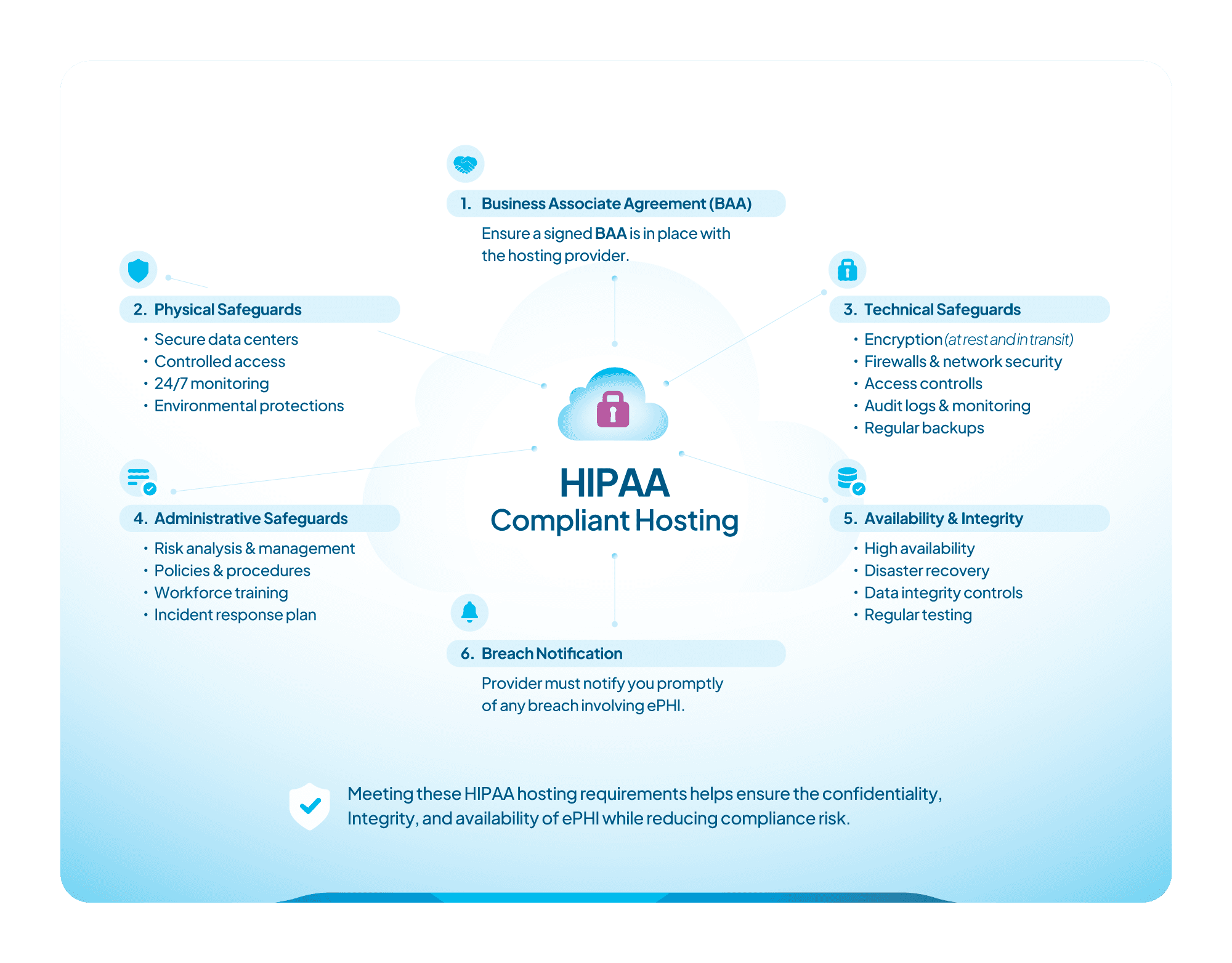
HIPAA hosting requirements exist to keep patient data secure wherever it's stored. When choosing a hosting provider, check two things: does the system have physical and technical safeguards in place, and has the provider signed a Business Associate Agreement (BAA)? (HHS.gov). In case you are wondering, the Business Associate Agreement (BAA) is a written agreement that establishes how a vendor will handle and protect PHI on behalf of a covered entity.
However, a signed BAA isn't the whole picture. As Jeremy Shiner has pointed out, patient data often moves beyond your main system, into AI tools or other add-ons connected to your EHR. Those systems need their own BAA, too. If a vendor was never brought under one, that's a gap, even if your primary provider is fully compliant.
The HIPAA Privacy Checklist for Small Practices
What are the HIPAA compliance requirements for small practices? This HIPAA compliance checklist covers what a small practice needs first:
Privacy
Appoint someone to own privacy compliance.
Post a Notice of Privacy Practices where patients can see it.
Apply the minimum necessary standard to every disclosure.
Give patients a clear way to request copies of, or corrections to, their records.
Have a process for handling patient privacy complaints.
People
Document who has access to PHI, and why.
Train every staff member who touches patient data.
Policies
Review and update policies at least annually.
While every healthcare specialty has a unique way of working workflows, the fundamentals remain the same. HIPAA compliance for dental offices often means paying closer attention to front-desk scheduling and imaging software. HIPAA compliance for medical offices usually centers on EHR access controls and referral communications.
Regardless of your specialty, the checklist above is the floor, whether you're operating as a HIPAA compliance for private practices or a multi-provider clinic.
HIPAA Compliance is a Continuous Process
HIPAA compliance is not a one-time task. Policies need to be reviewed, staff needs to be trained, risks need to be assessed, and safeguards need to be maintained as a practice's systems and workflows change.
For small practices, managing these requirements manually can quickly become difficult. Compliance management technology can help centralize documentation, organize tasks, track important activities, and give practices a clearer view of their ongoing compliance efforts.
Myriad Systems was recognized by MedTech Breakthrough for its compliance management approach, reflecting its focus on helping healthcare organizations manage complex compliance requirements through technology.
If you are looking for a more structured way to manage HIPAA compliance activities, schedule a walkthrough with Myriad Systems.
If you're also interested in learning how to secure your practice's electronic records, stay tuned for the next blog in this series, where we cover the HIPAA Security Rule: risk assessments, safeguards, and what small practices need in place, even without an in-house IT department.